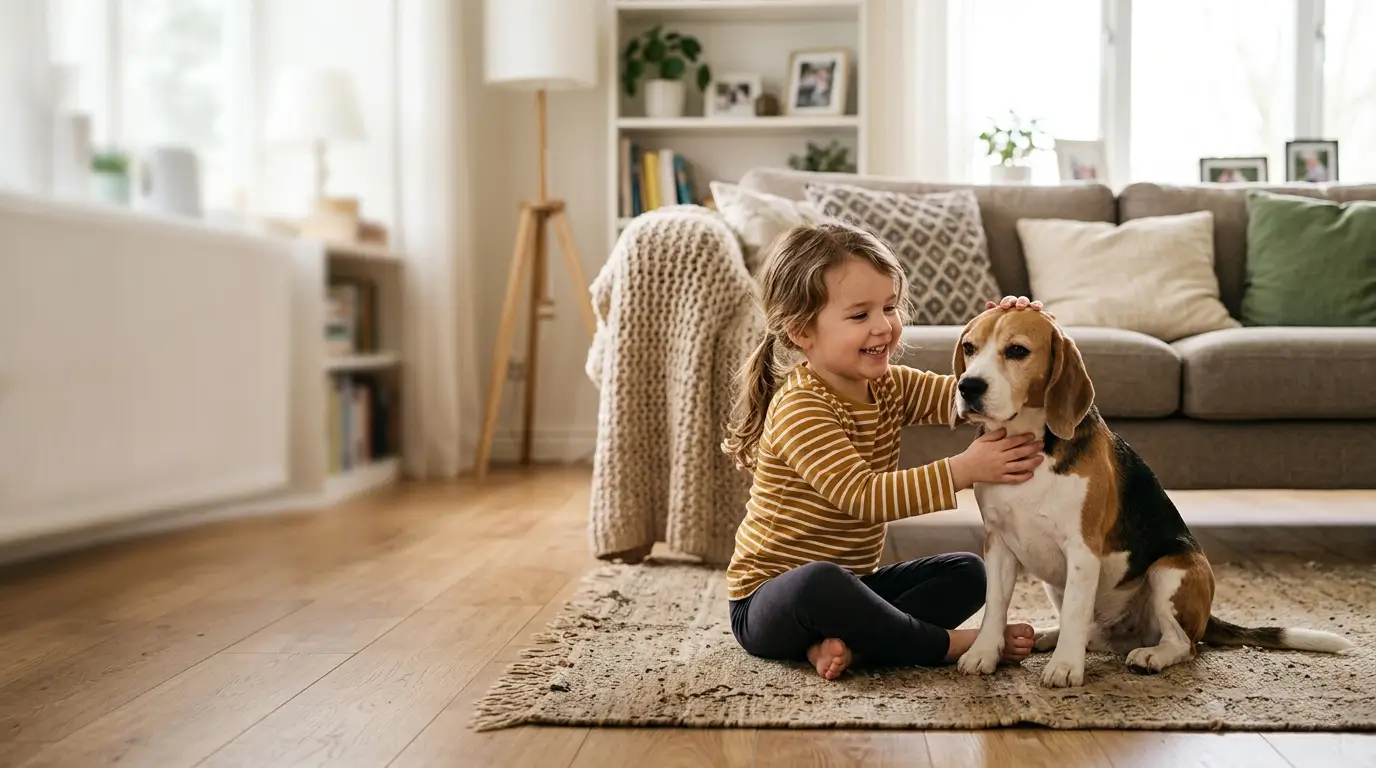
A three-year-old sits on the floor, trying to put a hat on the cat. The cat’s expression says “I did not sign up for this.” The child laughs. The parent takes a photo. The internet gets another viral video.
There is more behind that scene than entertainment. Children who grow up with animals learn to read emotions, build responsibility, and — as research confirms — develop stronger immune systems. But before you rush to the shelter, it helps to know what the science actually says and how to safely bring a pet into your child’s life.
Quick answer: do pets help with child development?
Yes — research points to benefits in three areas. First: emotional and social development. Children with pets show higher prosocial behavior and better emotional regulation. Second: immunity. Early exposure to household pets (especially dogs) reduces the risk of allergies and asthma. Third: responsibility. Daily feeding, walking, and caregiving build habits no educational app can replicate. The effect is not automatic — it requires the right age, adult supervision, and a healthy, well-socialized animal.
Newborn vs. puppy: who wins?
Before we get to the science, let’s clear the air. Any parent who has had a baby and a puppy at the same time knows: these two creatures have suspiciously much in common.
| Trait | Newborn | Puppy |
|---|---|---|
| Sleep per day | 16–17 hours | 18–20 hours |
| Wakes up at night | Yes, regularly | Yes, regularly |
| Communication | Crying | Whining |
| Favorite activity | Eating | Eating |
| Chewing things | From 6 months | Immediately |
| Needs carrying | Constantly | Tries, while under 3 kg |
| Full independence | ~18 years | ~2 years |
| Destroys shoes | Rarely | Always |
Key difference: a puppy goes to the bathroom outside after one year. With a newborn, that timeline is considerably longer.
Jokes aside, the comparison is not random. Caring for an animal trains the same “parenting muscles”: anticipating needs, patience, routine, and the ability to function on four hours of sleep.
What the science says: emotions and social skills
A systematic review by Purewal and colleagues published in the International Journal of Environmental Research and Public Health found positive associations between pet ownership and children’s emotional development — higher self-esteem, less loneliness, and better social competence. The effect was clearest in children aged 5 to 12.
A longitudinal study from the INMA project (published in 2025) went further: children who had contact with pets at age 1 and again at ages 4–5 showed fewer emotional problems at ages 7–8. The contact had to be regular and positive — a single encounter was not enough.
A separate 2023 study revealed the mechanism: parents talking to their children in the presence of a household pet used significantly more emotion and mental state language than during toy play. A dog or cat becomes a natural prompt for conversations about feelings — “look, Buddy is sad because we’re leaving” teaches a child to recognize emotions in a way no worksheet can match.
Research from Taiwan published in 2024 confirmed that pet caregiving builds children’s sense of connection with nature and strengthens prosocial behaviors — empathy, willingness to help, and cooperation skills.
Immunity: the hygiene hypothesis in action
This is one of the best-documented effects. A study in JAMA Pediatrics from 2015 found that early exposure to dogs reduced the risk of childhood asthma by roughly 15%. Exposure to farm animals reduced it by 52%.
The mechanism works through the gut microbiome. Tun and colleagues in a 2017 study (Microbiome) showed that infants in homes with furry pets had a richer gut microbiota — particularly higher levels of Ruminococcus and Oscillospira bacteria — which is linked to lower allergy risk.
A Japanese study from 2023 (Japan Environment and Children’s Study) added an important detail: reduced food allergy risk required pet exposure during both the prenatal period and early infancy. Exposure in only one of those windows did not produce the same protective effect.
In plain terms: a dog in the home is a natural supplier of microbes that “train” the infant immune system — before that system starts overreacting to pollen, dust mites, or foods.
When to bring a pet into a home with a small child
There is no single right answer, but pediatricians and animal behaviorists agree on several points:
Before the baby arrives — if the pet is already in the home, start preparing early. The dog should have basic commands down (sit, stay, go to place). The cat should have a safe retreat space. Begin acclimating the pet to baby sounds (recorded crying) and new smells (lotions, diapers).
Infant (0–12 months) — pet and baby are never left unsupervised. Even the gentlest dog can accidentally harm an infant — not from aggression, but from curiosity or enthusiasm. The immune benefits are strongest during this period — simply living in the same home with a pet changes the baby’s microbiome.
Toddler (1–3 years) — the hardest period. Toddlers grab, pull, and poke eyes. A normally patient dog or cat may react defensively. Supervision must be constant and active.
Preschooler (3–6 years) — the child starts understanding rules: we pet gently, we don’t pull tails, we leave the pet’s food alone. This is when you can begin delegating simple tasks — filling the food bowl under a parent’s watch.
School age (6+ years) — the child can take on real responsibility for part of the care. Walking the dog, cleaning the litter box, regular feeding. The American Academy of Pediatrics suggests that the emotional and educational benefits of pet ownership are most pronounced at this age.
Safety: non-negotiable rules
The data is clear: children under 5 are at the highest risk of dog bites. The AVMA (American Veterinary Medical Association) reports that most incidents involve dogs the child knows — family pets or relatives’ dogs.
Five rules:
- Never leave a young child alone with a pet. This applies to every animal, regardless of breed or temperament.
- Teach the child animal body language. Pinned ears, a stiff tail, a turned head — these signal “leave me alone.”
- Give the pet a safe zone. A place where the dog or cat can retreat when they’ve had enough. The child does not enter this zone.
- No face-to-muzzle contact. Especially with dogs — this is the most common circumstance for bites in young children.
- Keep the pet healthy. Regular vaccinations, deworming, vet checkups. A sick or suffering animal is less predictable.
Which pet for which child?
Not every animal suits every family. The AAP (American Academy of Pediatrics) suggests matching to age:
- Fish — from age 3. Minimal risk, teaches feeding routine, but limited emotional bonding.
- Hamster, guinea pig — from age 5–6. Requires gentleness that younger children rarely have.
- Cat — from age 6 (as “primary caregiver” under supervision). Independent but requires understanding of boundaries.
- Dog — from age 6 (as co-caregiver with a parent). Most interaction, most responsibility. Calm, patient breeds (Labrador, golden retriever, cavalier King Charles spaniel, beagle) work better in families with children than breeds with strong guarding instincts.
- Rabbit — from age 8. Fragile build, easily injured by improper handling. Requires patience and calm.
These are generalizations — an individual animal’s temperament matters more than species or breed.
Responsibility: what a pet teaches better than school
The list of duties “offloaded” onto a pet is, in practice, one of the most effective parenting programs:
- Routine — the dog eats at 7:00 and 18:00, whether it’s a weekend, a holiday, or a cartoon marathon day.
- Consequences — forget to fill the water bowl and the pet will find water elsewhere (usually the toilet).
- Empathy — “I’m fine” doesn’t cut it when the cat is limping. You have to observe, respond, and tell an adult.
- Loss — the hardest lesson. Pets live shorter lives than humans. For a child, the death of a hamster or dog is often the first confrontation with the death of someone close. Painful, but important.
Research confirms this mechanism: higher quality of the child-pet relationship correlates with better socio-emotional functioning in adolescence. It’s not about simply having a dog — it’s about active, engaged caregiving.
Frequently asked questions (FAQ)
Do household pets reduce allergy risk in children?
Research suggests yes — especially early exposure to dogs. A 2018 meta-analysis found a dose-response relationship: the more pets in the home, the lower the risk of allergic rhinitis and asthma. The mechanism works through enrichment of the infant gut microbiome. Important: if a child already has a diagnosed pet allergy, introducing a pet will not “cure” the allergy — consult an allergist.
At what age can a child independently care for a pet?
Full independent care is realistic from about age 10–12, depending on the child’s maturity and the animal species. Fish and hamsters require less — a 7–8-year-old can feed them independently with occasional oversight. Dogs require more — walking, training, responding to emergencies. Even teenagers need adult support for vet visits and medical decisions.
Can a dog or cat be jealous of a newborn?
Not in the human sense of jealousy, but the animal may experience stress from changed routines, less attention, and new sounds. Signs: withdrawal, inappropriate urination, destructive behavior (dogs), litter box avoidance (cats). Solution: gradual preparation before the birth, maintaining the pet’s routine, and providing their own space. If behaviors persist beyond 2–3 weeks, consult an animal behaviorist.
What diseases can pets transmit to children?
The most common zoonotic diseases in household settings are: ringworm (from cats), toxocariasis (from dogs — intestinal parasites), and toxoplasmosis (from cats, especially dangerous for pregnant women). Risk is minimized by: regular deworming, vaccinations, hand washing after pet contact, and keeping children and pregnant women away from litter boxes. With a healthy, regularly examined pet, the risk is low.
Does apartment living rule out having a pet with a child?
No. Many dog breeds (cavalier King Charles spaniel, bichon frise, pug) adapt well to apartment living. Cats are naturally indoor animals. What matters: providing the pet with exercise (walks, play) and a safe space away from the child. Apartment size matters less than the amount of attention and activity.
Sources
- Companion Animals and Child/Adolescent Development: A Systematic Review — Purewal et al. (2017)
- Impact of pet ownership in early childhood on mental health — INMA Project (2025)
- The impact of household pets on children’s daily lives — parent-child conversations study (2023)
- Pet caregiving, social well-being and nature connection among children (2024)
- Early Exposure to Dogs and Farm Animals and the Risk of Childhood Asthma — JAMA Pediatrics (2015)
- Exposure to household furry pets influences the gut microbiota of infants — Tun et al. (2017)
- Pet-keeping in early life reduces the risk of allergy in a dose-dependent fashion (2018)
- Fetal and infancy pet exposure and food allergies — Japan Environment and Children’s Study (2023)
- Longitudinal Associations Between Pet Relationship Quality and Socio-Emotional Functioning (2024)
- AVMA Dog Bite Prevention Resources
Related articles
Summary
A pet is neither a toy nor an educational tool — but it does both jobs on the side. Research confirms that children growing up with animals develop stronger emotional and social skills, face fewer allergies, and learn responsibility earlier. The condition — proper preparation, supervision, and a healthy animal. Not every species suits every age. A baby and a dog can coexist safely, but they require constant adult attention. Preschoolers can start helping, and school age is a good time to delegate real responsibilities. Whether you have a Labrador, a cat, or a hamster — the most valuable thing a pet gives a child is daily practice in empathy. No app can replace that. But an app can help you keep the pet healthy, so it stays with the family as long as possible.