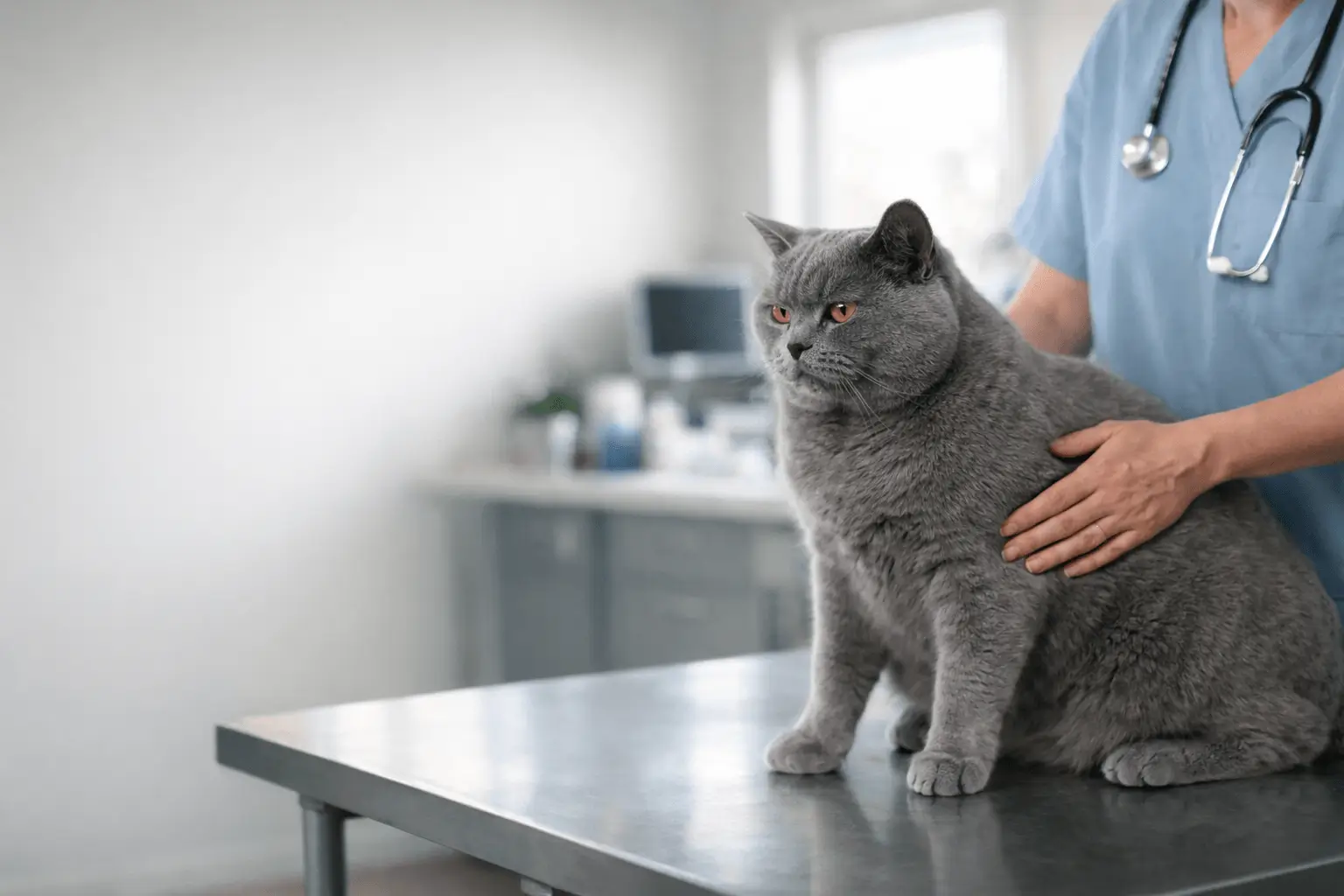
The cat finishes breakfast, stares at you until you add a bit more, curls up in the warm spot and does not move for four hours. You assume this is just cat behaviour. The vet looks at her and says she has put on weight. You are surprised — she seems fine.
Cat obesity is harder to notice than dog obesity. Cats hide excess weight under their coat, carry it differently than dogs, and often do not change their behaviour in ways that make the problem obvious. By the time most owners notice, the extra weight has been there for a while.
Around 60% of cats in Europe are overweight or obese, making it the most prevalent preventable health condition in companion cats today. The good news: it is reversible. The first step is knowing how to actually assess your cat.
Quick answer: is my cat overweight?
Run both hands firmly along your cat’s ribcage. You should feel each rib easily with light pressure — like touching the back of your hand. If you have to press to find them, there is a fat layer that should not be there. If you cannot feel them at all, obesity is likely. Check the base of the tail: a thick fat pad there is a reliable early sign. A vet visit gives you a precise score and a target weight to aim for.
How to assess your cat’s body condition
Vets use the Body Condition Score (BCS) — a 9-point scale where 4–5 is ideal. Scores of 6–7 indicate overweight; 8–9 indicate obesity.
You do not need the exact number. You need to know what to check at home.
The rib test: Place both hands along the sides of the ribcage and press gently. At ideal weight, ribs are easy to feel with minimal pressure — like touching the back of your knuckles. If it feels more like pressing your palm, there is a fat layer over the ribs.
The base of the tail: Slide your fingers along the spine toward the base of the tail. You should feel the vertebrae and tail bones with little effort. A thick, soft fat pad in this area is one of the most reliable signs of excess weight in cats — and one owners most often miss because the coat conceals it.
The waist check: Look at your cat from above. There should be a visible taper between the last rib and the hips — a slight hourglass shape. Viewed from the side, the belly should rise slightly toward the hindquarters. A belly that hangs low or is clearly rounded indicates excess abdominal fat.
The belly pouch vs. fat: Many cats have a flap of loose skin along the lower abdomen (the primordial pouch) — this is normal, not a sign of obesity. The rib test and tail base test are more reliable indicators than belly shape alone.
What the scale tells you: Ideal weight varies significantly by breed and frame. A Maine Coon at 7 kg may be healthy; a Domestic Shorthair at 7 kg is likely obese. Ask your vet for a target weight specific to your cat’s build.
Why cats gain weight
Portion creep. Feeding guidelines on cat food bags are often set for a range of activity levels and can be 20–30% above what a typical indoor cat actually needs. Small daily overages accumulate invisibly over months.
Free feeding. Leaving food available all day — common with dry food — removes the natural regulation that comes from meal feeding. Many cats self-regulate fine; many others eat out of boredom.
Reduced activity. Indoor-only cats, especially in flats without access to outdoor space, have far lower calorie needs than the same cat roaming outside. A cat that once explored a garden and now sleeps on a radiator needs significantly less food.
Age. Older cats have lower metabolic rates. A feeding plan that kept a three-year-old cat lean can cause slow, steady weight gain in the same cat at eight.
Neutering. Neutered cats have lower energy requirements — studies estimate around 20–30% less. Most owners do not adjust feeding after surgery. That is where the weight gain typically starts.
Treats and human food. Cat treats are often calorie-dense. Scraps of fish, chicken, or dairy add up faster than owners realise.
Medical causes. Hypothyroidism is rare in cats but does occur. More relevant: insulinoma and other hormonal conditions can affect appetite and metabolism. If your cat is gaining weight despite a controlled diet, a blood panel is worth doing.
What excess weight does to your cat’s health
The consequences of obesity in cats are serious and well-documented.
Diabetes. Obesity is the primary risk factor for type 2 diabetes in cats. Overweight cats have significantly higher rates of insulin resistance — for many, reaching a healthy weight can normalize blood glucose without lifelong insulin therapy. This is one of the strongest arguments for taking cat weight seriously.
Hepatic lipidosis (fatty liver disease). When overweight cats stop eating — due to illness, stress, or sudden food restriction — the body mobilizes fat rapidly and overloads the liver. Hepatic lipidosis is life-threatening and disproportionately affects obese cats. It is also why cat weight loss must be gradual and supervised.
Urinary tract disease. Overweight cats have higher rates of lower urinary tract problems, including feline idiopathic cystitis and urethral obstruction. The connection is partly metabolic, partly related to reduced water intake and movement.
Joint disease. Excess weight accelerates osteoarthritis in cats, though the signs are subtler than in dogs — cats rarely limp visibly, but they stop jumping to high surfaces, groom their back less, and become less active.
Grooming problems. Cats that cannot reach parts of their body due to abdominal fat stop grooming those areas, leading to matting, skin infections, and increased risk of parasites.
Lifespan. Studies consistently show that cats maintained at ideal weight live longer and have fewer chronic disease complications than their overweight counterparts.
How to help your cat lose weight safely
This is the critical constraint for cats: weight loss must be slow. A rapid drop in calorie intake can trigger hepatic lipidosis. Safe pace is 0.5–1% of body weight per week — slower than for dogs.
Step 1: Get a target weight and calorie goal from your vet. Before changing anything, confirm a safe target weight. Your vet can also rule out medical causes and give you an accurate daily calorie ceiling. Guessing the target leads to either too-slow progress or dangerous restriction.
Step 2: Switch to meal feeding if you free-feed. Two or three measured meals per day instead of food available all day. This is often the single most impactful change for chronically overweight cats.
Step 3: Measure food in grams. Kitchen scale, every meal. Most owners overpour dry food by 20–30% when using cups or scoops. Wet food is easier to portion accurately and helps with water intake — an added benefit for urinary health.
Step 4: Use a veterinary weight management diet. These are formulated to be calorie-restricted while maintaining adequate protein — essential for cats, which are obligate carnivores. Feeding less of a standard maintenance diet risks protein and nutrient deficiencies over time. High-protein, moderate-fat, low-carbohydrate diets are generally preferred for weight management in cats.
Step 5: Reduce treats; do not eliminate them entirely. If you use treats, count them against the daily calorie budget. Single-ingredient freeze-dried protein treats are lower-calorie options. Avoid dairy, fish scraps, and commercial treats with sugar or fillers.
Step 6: Increase activity. Cats do not walk on leashes (mostly). But movement can be stimulated: puzzle feeders, wand toys for 10–15 minutes of active play twice a day, food-dispensing balls, vertical spaces (cat trees, shelves) to encourage climbing. Moving more is nearly as important as eating less — and it supports muscle preservation during weight loss.
Step 7: Weigh every 2–3 weeks and adjust. If weight is not moving after 3–4 weeks, reduce calories by 10%. If the cat is losing faster than 1% of body weight per week, increase slightly. Never stop feeding abruptly.
Keeping track of weight and progress
Cat weight management programs typically run 4–12 months. The challenge is not the plan — it is consistency over time, especially in households with multiple cats or when the cat finds creative ways to access food.
Things that help:
- A fixed weigh-in every 2 weeks, logged in one place.
- A record of the specific food, exact portion in grams, and any treats given.
- Notes on behaviour — is the cat jumping up again? Grooming better? More playful?
VetNote lets you log weight measurements over time directly in your cat’s profile, set regular weigh-in reminders, and build a progress record to share with your vet. When the vet asks how the diet is going at the six-month recheck, you have actual data.
Frequently asked questions (FAQ)
How can I tell if my cat is overweight if they have long fur?
Long fur makes visual assessment unreliable. Use the rib test and the base-of-tail check — these are tactile, not visual, and coat length does not affect them. You should feel individual ribs and tail vertebrae easily. A thick, firm fat pad at the tail base is the most consistent indicator in long-haired breeds.
My cat has always been large — could it just be their build?
Some breeds are genuinely large (Maine Coon, Norwegian Forest Cat, Ragdoll), but body size does not exempt them from being overweight. Apply the same rib and tail tests. A big cat can still have easily palpable ribs and a visible waist. If the ribs are buried in fat regardless of size, the cat is carrying excess weight.
My vet said my cat is overweight, but she seems fine and is active. Should I still act?
Cats are good at hiding discomfort. The absence of obvious symptoms does not mean the weight is not damaging joints, stressing the metabolic system, or increasing diabetes risk. The earlier you address it, the easier the correction — and the less likely you are to be managing diabetes or hepatic lipidosis later.
Is wet food better than dry food for overweight cats?
For most overweight cats, yes. Wet food has significantly higher moisture content (70–80% vs. 8–10% in dry food), which supports urinary health and typically means fewer calories per volume. It is also easier to portion accurately. High-protein, low-carbohydrate wet food is generally the preferred format for cat weight management.
Can I just put less food in the bowl instead of switching to a diet food?
Reducing quantity of a standard maintenance diet risks nutritional deficiencies, particularly protein, over a multi-month program. Veterinary weight management diets are designed to be calorie-restricted while keeping essential nutrients at adequate levels. They are worth using for any cat on a program longer than a few weeks.
Sources
- WSAVA Global Nutrition Guidelines — Body Condition Scoring (World Small Animal Veterinary Association)
- Pet obesity management: beyond nutrition (Linder & Mueller, Veterinary Clinics of North America: Small Animal Practice, 2014)
- Epidemiology of feline obesity in Great Britain: cross-sectional study of 47 practices (Courcier et al., Veterinary Record, 2012)
- Feline Hepatic Lipidosis (Valtolina & Favier, Veterinary Clinics of North America: Small Animal Practice, 2017)
- 2021 AAHA Nutrition and Weight Management Guidelines for Dogs and Cats (American Animal Hospital Association)
Related articles
- Dog and cat vaccination calendar
- How to keep a dog’s treatment history step by step
- Spring pet safety: toxic plants, parasites and seasonal hazards
Summary
Cat obesity is common, quiet, and consequential. Around 60% of cats in Europe carry excess weight, and most owners are unaware until a vet points it out — because cats hide it well and rarely complain visibly. The rib test and base-of-tail check give you a reliable home assessment in under a minute. Your vet gives you a safe target weight and calorie plan. From there, the plan is: switch to meal feeding, measure food in grams, increase active play, weigh every two weeks, adjust slowly. The hard constraint with cats is that weight loss must be gradual — rapid restriction is dangerous. Tracking your cat’s weight, food, and progress consistently over months is what makes the difference between a plan that holds and one that quietly drifts back to the starting point.