You walk into the vet’s office and hear: “When did he start eating less?”. You look at the ceiling. Three days ago? A week? Hard to say, because that one evening when he left half his bowl, he did not seem sick yet.
Most vet visits start like this. You watch your dog or cat every day, but small changes slip by because nobody writes them down. An AI pet health guardian does exactly that: it remembers, compares, and flags when something drifts from normal.
Quick answer: what is an AI pet health guardian
A system that helps pet owners keep daily observations about their dog or cat and spot worrying patterns faster than memory alone. It does not diagnose and it does not replace the vet. Think of it as a patient assistant that never forgets and always asks the right questions.
You already track your pet’s health without realizing it
Every owner does the same thing: glances at whether the pet eats, wants to go outside, acts like usual. The problem is that those observations stay in your head and fade within days.
A few examples:
- your cat drank less for two days, went back to normal, and you forgot about it,
- the dog had diarrhea on Friday, felt fine by Monday, and you never brought it up at the vet,
- your pet has been sleeping longer than before for weeks, but the shift was so gradual nobody noticed.
Each of those carried information the vet could have used. AI turns fleeting observations into data you can actually go back to.
What this looks like day to day
No complicated screens or charts. In practice it works like this:
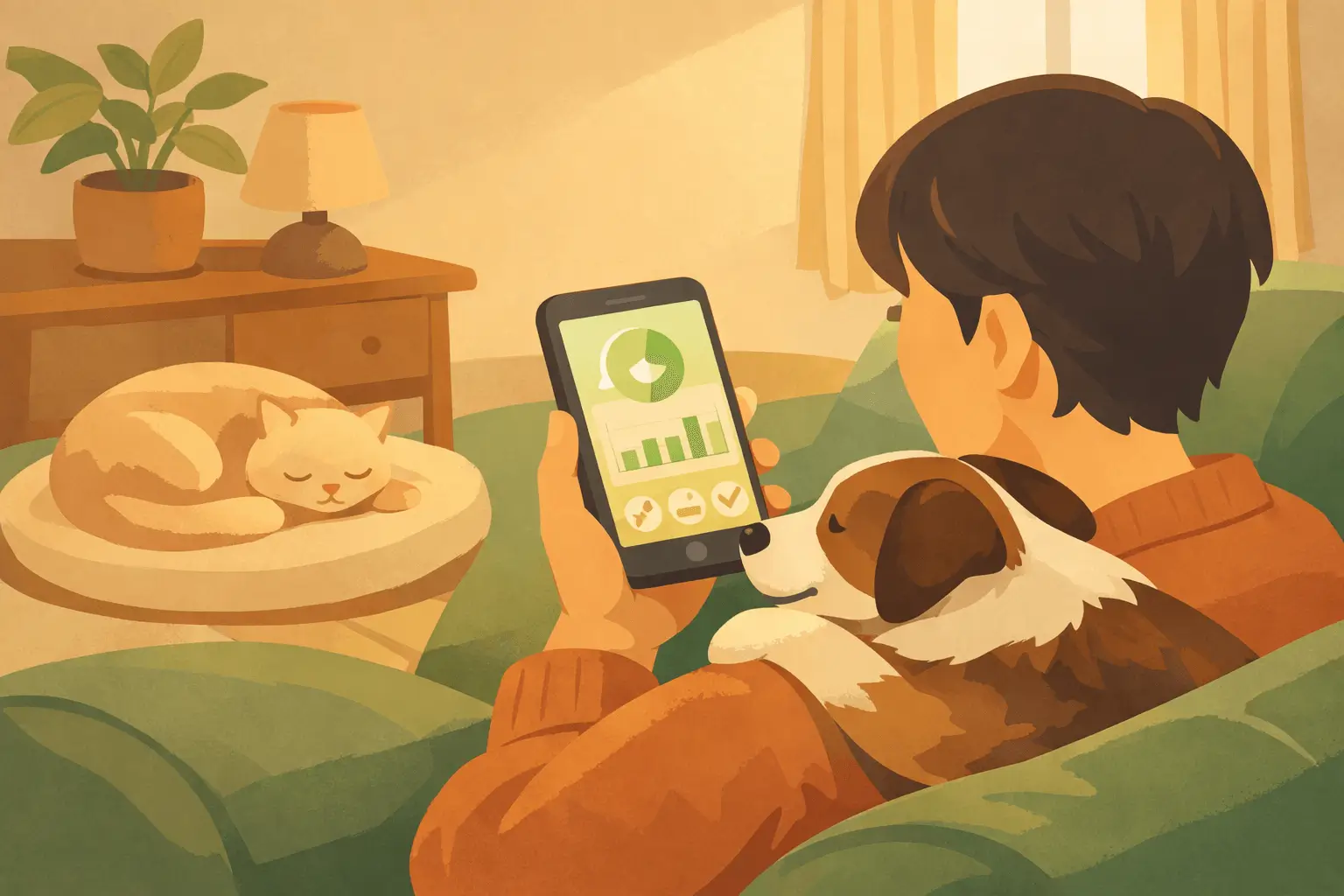
A short question once a day. “How is Buddy feeling today?”. You tap one of the options or type a sentence. Takes about 10 seconds.
Change detection. After a few weeks the system has enough data to compare. It might say: “Buddy has eaten less than usual for 4 days” or “You have logged lower activity for a week straight”.
Reminders. Based on vaccination and visit history, AI nudges you when the next vaccine, deworming, or check-up is coming up.
A summary before the appointment. Instead of retelling from memory, you can show the vet a concrete timeline from recent weeks.
Why this works better than phone notes
You could say: “I can just write it in my notes app”. In theory, sure. In practice, nobody keeps it up past a week.
- No structure. Notes end up written differently every time. After a month you cannot compare anything.
- No continuity. Skip one day and the habit breaks. AI prompts you on its own, so the routine sticks.
- No analysis. Human brains struggle with gradual changes. If something worsens a little each day, we catch on after two weeks. An algorithm flags it after three days.
The difference is roughly like taking photos versus recording video. Photos grab moments. Video shows which direction things are heading.
What an AI pet health guardian does NOT do
Worth stating clearly, because there is a lot of confusion around AI and health:
- It does not diagnose. You will not hear “your dog has an infection”. You might get something like “Buddy has had a fever and lower appetite for 3 days, it may be worth booking a visit”.
- It does not replace the vet. Medical decisions belong to the veterinarian. AI gives them better data to work with.
- It does not read test results. Blood panels, ultrasounds, X-rays — a specialist interprets those. AI helps keep them in one place.
- It does not prescribe. No drug suggestions, no dosages, no treatment plans.
AI stops where medicine starts. That is a feature, not a limitation — you know the tool is not trying to play doctor.
Prevention instead of damage control
Most owners operate reactively: the pet gets sick, then we go to the vet. Meanwhile, vets keep saying that regularity and early detection are what matter most.
AI helps shift to that model:
- daily logging builds a full health picture over time,
- the system compares against your specific pet’s baseline, not a generic average,
- the vet gets a history that leads to faster, more accurate responses,
- you get peace of mind knowing nothing important slipped through.
This is not a big change. It is better organization of something you already do, just until now only in your head.
How to start
No need to wait. You can build the habit today:
- Pick one place for all your pet’s health records.
- Spend 30 seconds a day noting how your dog or cat is doing.
- After every vet visit, log the diagnosis, medications, and recommendations.
- Before the next visit, skim recent entries and bring the vet specifics instead of guesses.
The more data you collect, the more AI can do with it: find patterns, send reminders, build summaries.
Frequently asked questions (FAQ)
Can AI replace a vet visit?
No. An AI pet health guardian is not a diagnostic tool. It collects and organizes information you then share with the vet. Medical decisions always belong to the veterinarian.
Is my data safe?
Pet medical data is sensitive. Look for solutions with encryption, full access control, and no third-party sharing without your consent.
Does this only work for dogs?
No. It works for dogs, cats, and other domestic animals. Every pet has its own behavioral patterns that can be tracked and compared over time.
How much time does it take each day?
A daily check takes 10-30 seconds. A more detailed entry after a vet visit runs 2-3 minutes.
Sources
- The potential application of artificial intelligence in veterinary clinical practice and biomedical research (PMC, 2024)
- Development of an Early Warning System for Owners Using a Health-Related Quality of Life Instrument (PMC, 2020)
- Digital Revolution in Animal Health (HealthForAnimals)
- Artificial intelligence and companion animals: Perspectives on digital healthcare for dogs, cats, and pet ownership (ScienceDirect, 2025)
Related articles
- How to keep a dog’s treatment history step by step
- What to bring to a first vet appointment
- Dog and cat vaccination calendar
Summary
An AI pet health guardian is not a futuristic concept but a practical tool for something every owner wants to do: watch their pet closely and know that nothing important went unnoticed. The vet gets real data instead of “I think he has been eating less since Tuesday”, and you stop relying on memory. The best time to start is today — every logged day adds another piece to your pet’s complete health history.