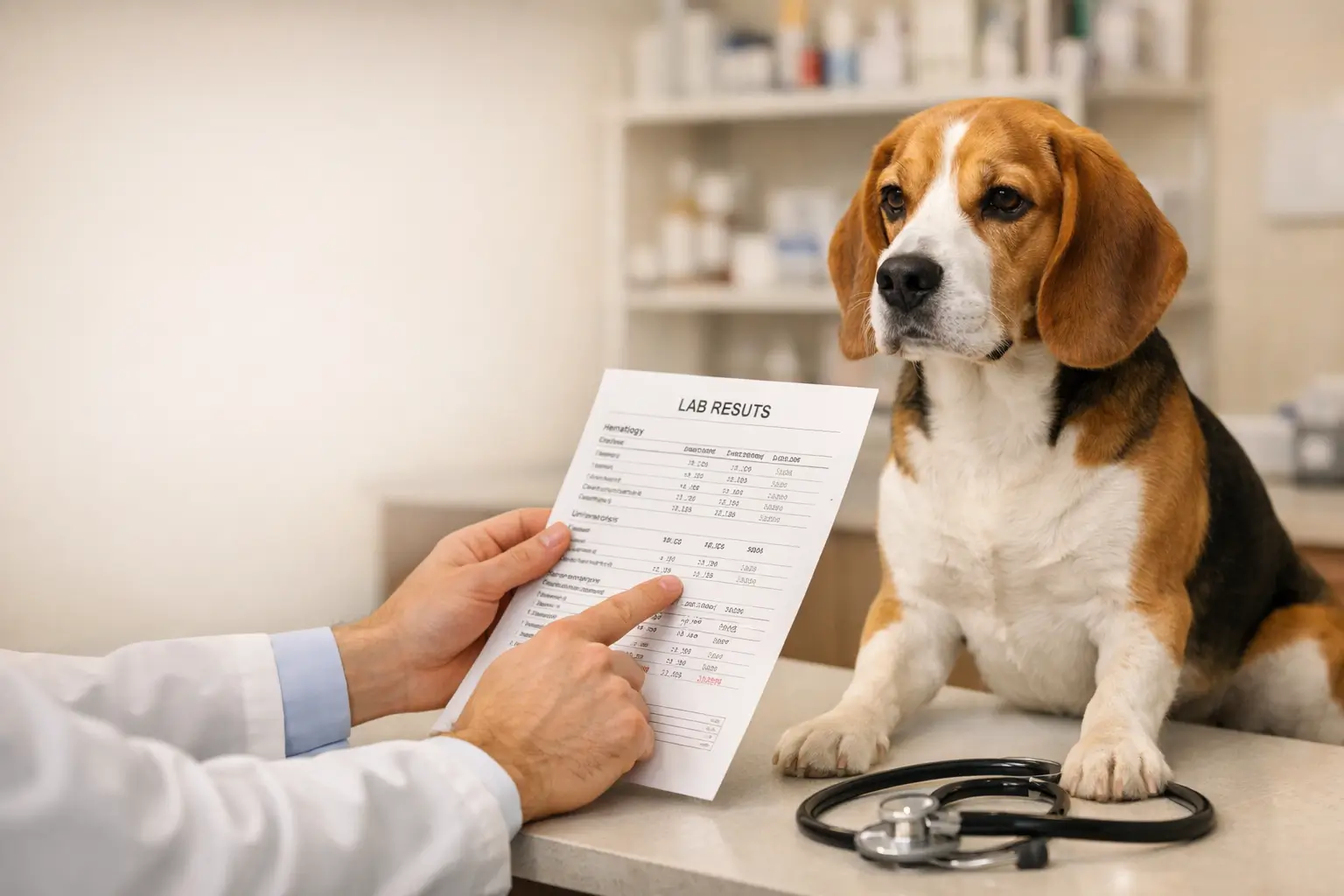
Your vet runs blood work. A few hours later you get the results — a page of abbreviations, numbers, and reference ranges. Some values are bolded. Some are flagged high or low. The vet says everything looks “mostly fine” and moves on. You’re left wondering what “mostly” means.
Blood tests are the single most common diagnostic tool in veterinary medicine. A standard panel can flag kidney disease, liver problems, infections, anaemia, diabetes, and a dozen other conditions — often before your pet shows any visible symptoms. The catch: the results are only useful if someone actually reads them. And that someone should include you.
This guide covers the two core panels — the complete blood count (CBC) and the blood chemistry profile — in language that does not require a veterinary degree. It applies to dogs and cats, with specific notes where the species differ.
Quick answer: what do dog blood test results mean?
A standard blood panel has two parts. The CBC (complete blood count) measures red blood cells, white blood cells, and platelets — it reveals anaemia, infections, clotting issues, and immune activity. The blood chemistry panel measures organ function: liver enzymes (ALT, ALP, GGT), kidney markers (BUN, creatinine), blood glucose, proteins, and electrolytes. Values outside the reference range do not always mean disease — context matters. A single abnormal result is a data point. A trend over multiple tests is a diagnosis.
Why vets order blood work
Not every blood draw means something is wrong. The three main reasons:
Pre-surgical screening. Before anaesthesia, your vet needs to know the liver can metabolise drugs and the kidneys can clear them. A 2023 study in the Journal of the American Veterinary Medical Association found that pre-anaesthetic blood work changed the surgical plan in 8.4% of apparently healthy dogs.
Wellness screening. Annual or biannual panels for healthy animals, especially over age 7. The goal is establishing a baseline and catching organ decline early — kidney disease in cats, for instance, is detectable in blood work well before clinical signs appear.
Diagnostic workup. Your pet is sick, lethargic, losing weight, vomiting, drinking too much water. Blood work narrows the list of possible causes from dozens to a handful.
The complete blood count (CBC)
The CBC counts the cellular components of blood. Three groups matter:
Red blood cells (RBC)
Red blood cells carry oxygen. The key values:
- RBC count — total number of red cells per microlitre
- Haematocrit (HCT) / packed cell volume (PCV) — percentage of blood that is red cells. Normal in dogs: 37–55%. Normal in cats: 30–45%.
- Haemoglobin (HGB) — oxygen-carrying protein inside red cells
Low values (anaemia): The animal is not carrying enough oxygen. Causes range from blood loss (trauma, parasites, gastric ulcers) to destruction (immune-mediated haemolytic anaemia) to production failure (bone marrow disease, chronic kidney disease). A haematocrit below 20% in a dog is clinically significant and often requires intervention.
High values (polycythaemia): Less common. Can be caused by dehydration (relative — the blood is simply more concentrated) or, rarely, by bone marrow overproduction.
White blood cells (WBC)
White blood cells fight infection and mediate immune responses. The total WBC count matters, but the differential — the breakdown by cell type — tells the real story.
- Neutrophils — first responders to bacterial infections. High count (neutrophilia) usually means active infection or inflammation. Very low count (neutropenia) can indicate bone marrow suppression or overwhelming sepsis.
- Lymphocytes — manage chronic infections and immune regulation. Elevated in chronic infections, some leukaemias. Low in acute stress or steroid use.
- Eosinophils — associated with allergic reactions and parasitic infections. High count points to parasites, allergies, or certain immune conditions.
- Monocytes — chronic inflammation cleanup crew. Elevated in long-standing infections or tissue damage.
In cats specifically: Stress from the vet visit itself can cause a “stress leukogram” — elevated neutrophils and lymphopenia — which is a normal physiological response, not disease.
Platelets (PLT)
Platelets enable clotting. Normal range in dogs: 175,000–500,000/μL.
Low platelet count (thrombocytopenia): Risk of abnormal bleeding. Causes include immune-mediated thrombocytopenia (IMTP), tick-borne diseases (ehrlichiosis, anaplasmosis), bone marrow disorders, or disseminated intravascular coagulation (DIC). In Poland, tick-borne diseases are a common culprit in dogs that spend time outdoors.
Clumping artefact: Platelets in cats frequently clump in the collection tube, giving a falsely low count. If your cat’s platelet count looks alarmingly low but the vet says “likely clumping” — that’s a real phenomenon, not a brush-off.
Blood chemistry panel: organ function
The chemistry panel measures substances in the liquid part of blood (serum or plasma). Each group of values maps to a specific organ or system.
Liver values
The liver processes toxins, produces bile, synthesises proteins, and stores glycogen. Multiple enzymes rise when liver cells are damaged or bile flow is obstructed.
- ALT (alanine aminotransferase) — the most liver-specific enzyme in dogs. Elevated ALT means liver cell damage. Does not say how severe — a mild elevation can be more significant than a dramatic spike, depending on context.
- ALP (alkaline phosphatase) — rises with bile duct obstruction, steroid use (including Cushing’s disease), bone growth in young animals, and certain medications. Less specific than ALT. In cats, even a mild ALP elevation is significant because cats have much less ALP in their liver than dogs.
- GGT (gamma-glutamyl transferase) — confirms biliary disease when elevated alongside ALP.
- Bilirubin — a breakdown product of haemoglobin. Elevated bilirubin causes jaundice (yellow gums, skin, whites of eyes). Can indicate liver disease, bile duct obstruction, or massive red blood cell destruction.
- Albumin — a protein made exclusively by the liver. Low albumin can mean liver failure, protein-losing kidney disease, or protein-losing gut disease.
What a “high ALT” actually means: A mildly elevated ALT (2–3x normal) that is stable over multiple tests may reflect a benign condition or a slow process. An ALT that jumps from normal to 10x normal in two weeks signals acute liver damage. This is why a single result is less valuable than a series of results over time.
Kidney values
The kidneys filter waste, regulate hydration, and maintain electrolyte balance. Two markers dominate:
- BUN (blood urea nitrogen) — a waste product from protein metabolism. Rises when kidneys lose filtering capacity. But also rises with dehydration, high-protein meals, and gastrointestinal bleeding — so BUN alone is not kidney-specific.
- Creatinine — a waste product from muscle metabolism. More kidney-specific than BUN. Elevated creatinine reliably indicates reduced kidney filtration (reduced glomerular filtration rate, or GFR).
- SDMA (symmetric dimethylarginine) — a newer marker adopted since 2015 by IDEXX. Rises earlier than creatinine — at approximately 25% loss of kidney function vs. 75% for creatinine. If your vet’s lab reports SDMA, pay attention to it.
Kidney disease staging (IRIS): The International Renal Interest Society classifies chronic kidney disease (CKD) into 4 stages based on creatinine and SDMA values. In cats, CKD is extremely common — by some estimates, over 30% of cats over 15 years old have it. Early detection via blood work (especially SDMA trends) is the primary means of slowing progression with dietary and medical management.
Glucose
- Normal fasting glucose in dogs: 74–143 mg/dL (4.1–7.9 mmol/L)
- Normal fasting glucose in cats: 74–159 mg/dL (4.1–8.8 mmol/L)
High glucose (hyperglycaemia): Can indicate diabetes mellitus — but in cats, stress hyperglycaemia is very common. A stressed cat at the vet can easily show glucose of 200+ mg/dL without being diabetic. If glucose is high, your vet may recommend a fructosamine test (which reflects average glucose over the previous 2–3 weeks) to distinguish true diabetes from a stress spike.
Low glucose (hypoglycaemia): Unusual and potentially dangerous. Causes include insulin overdose (in diabetic pets), liver failure, sepsis, or insulinoma (pancreatic tumour). Puppies of toy breeds are prone to hypoglycaemia from skipped meals.
Pancreatic markers
- Lipase / spec cPL (canine pancreatic lipase) / spec fPL (feline): Elevated in pancreatitis. The species-specific tests (SNAP cPL, Spec cPL) are much more accurate than the older general lipase assay.
- Amylase — historically used for pancreatitis, now considered unreliable in dogs and cats. If your vet still reports it, the specific lipase tests are more meaningful.
Electrolytes and minerals
- Sodium, potassium, chloride — electrolyte imbalances indicate dehydration, kidney disease, Addison’s disease (low sodium, high potassium), or vomiting/diarrhoea.
- Calcium — elevated calcium can signal cancer (lymphoma, anal sac adenocarcinoma), hyperparathyroidism, or kidney disease. Low calcium: eclampsia in lactating dogs, hypoparathyroidism.
- Phosphorus — rises with kidney disease. The calcium-phosphorus ratio matters for CKD management.
Thyroid
- T4 (thyroxine) — the standard screening test. High T4 in cats means hyperthyroidism (very common in older cats). Low T4 in dogs suggests hypothyroidism. Both conditions are manageable with medication once diagnosed.
When values are outside the reference range
A flagged value is not a diagnosis. Several factors cause results to fall outside the printed reference range in healthy animals:
Breed variation. Greyhounds normally have higher haematocrits (up to 65%) and lower platelet counts than other breeds. Shiba Inus and Akitas have higher potassium levels. Labrador retrievers can have higher ALT and ALP without liver disease.
Age. Puppies and kittens have different reference ranges than adults — ALP is normally higher in growing animals due to bone activity.
Stress and excitement. Especially in cats, stress from transport and handling causes measurable changes in glucose, WBC differential, and sometimes even lactate.
Recent meals. Lipemia (fat in the blood from a recent meal) can interfere with several chemistry values. Fasting for 8–12 hours before blood draw improves accuracy — ask your vet if fasting is needed.
Dehydration. Mild dehydration concentrates blood, artificially elevating values like protein, haematocrit, and BUN.
The rule: one abnormal value on one test, in an animal that feels fine, is usually worth monitoring — not panicking about. When two or more values point in the same direction, or when the same value is consistently abnormal across tests, that warrants investigation.
How often should your pet have blood work
There is no single answer, but veterinary guidelines converge:
- Young, healthy animals (1–6 years): Baseline panel, then every 1–2 years or before procedures
- Middle-aged (7–10 years): Annual panels — organ decline starts here
- Senior (10+ years): Every 6 months — kidney and liver values can shift quickly
- Chronic illness (CKD, diabetes, thyroid): As often as your vet recommends — sometimes monthly during stabilisation
The AAHA (American Animal Hospital Association) 2023 Senior Care Guidelines recommend biannual lab work for dogs over 7 and cats over 11, explicitly because early detection of CKD, diabetes, and thyroid disease changes treatment outcomes.
Blood work for cats: key differences from dogs
Cats are not small dogs. Several blood work interpretations differ:
- Stress leukogram — common in cats, rare in dogs. Elevated neutrophils + low lymphocytes from handling stress.
- Stress hyperglycaemia — glucose above 200 mg/dL from stress alone. Fructosamine differentiates from diabetes.
- ALP sensitivity — even mildly elevated ALP in cats is more concerning than a moderate elevation in dogs.
- Platelet clumping — near-universal in cat blood samples. Low platelet counts in cats must be verified with a blood smear.
- CKD prevalence — chronic kidney disease affects an estimated 1 in 3 cats over 15. SDMA and creatinine monitoring starting from age 7 is a reasonable approach.
- Hyperthyroidism — the most common endocrine disease in older cats. T4 screening is standard from age 8–10.
How to track lab results over time
A single blood test is a photograph. A series of tests over months or years is a film — and the film is what catches disease early.
The concept is simple: if your dog’s creatinine has been 1.2, 1.3, 1.2, 1.4 mg/dL over four years — and suddenly it is 1.9 — that trend matters even though 1.9 may still fall within the “normal” reference range. A value that is technically normal but rising steadily is more informative than a single flagged value.
The problem is practical: most pet owners lose lab printouts, switch vets, or simply forget what the numbers were two years ago. This is the exact problem VetNote solves. You can photograph or upload lab results to your pet’s profile, store values over time, and see the trend at a glance. When you consult a new vet or a specialist, you bring the full history — not a guess about what the liver enzymes were “last time.”
Frequently asked questions (FAQ)
What does a high ALT mean in a dog’s blood test?
ALT (alanine aminotransferase) is a liver enzyme that rises when liver cells are damaged. A mild elevation (2–3x normal) can result from medications, mild infections, or metabolic stress. A large spike (5–10x+ normal) suggests acute liver damage from toxins, infection, or bile duct obstruction. Context matters: a single mildly elevated ALT in an otherwise healthy dog is worth rechecking in 4–6 weeks, not an emergency.
What is SDMA and why is it better than creatinine for kidney disease?
SDMA (symmetric dimethylarginine) is a kidney biomarker that rises when approximately 25% of kidney function is lost — much earlier than creatinine, which does not rise until roughly 75% of function is gone. This early detection window allows dietary and medical intervention while more kidney function remains. SDMA has been widely available on veterinary panels since 2016.
Can stress affect my cat’s blood test results?
Yes, significantly. A stressed cat at the vet commonly shows elevated blood glucose (stress hyperglycaemia, sometimes above 200 mg/dL), changes in the white blood cell differential (stress leukogram), and falsely low platelet counts from clumping. Your vet accounts for this — fructosamine testing can confirm whether high glucose reflects true diabetes or stress.
How often should senior dogs and cats have blood work?
The AAHA recommends biannual lab work for dogs over 7 and cats over 11. At this age, kidney disease, liver disease, diabetes, and thyroid conditions can develop between annual visits. Every-6-months testing catches shifts early enough to change treatment outcomes.
My dog’s blood work has one value slightly outside the normal range. Should I be worried?
Usually not. Reference ranges are built from population data — 5% of healthy animals will fall outside them by definition. Breed differences, recent meals, mild dehydration, and stress all push values out of range without disease. Worry when: multiple values point to the same organ, the abnormality persists or worsens across tests, or your pet has clinical signs that match the lab findings.
Sources
- IRIS Staging of CKD — International Renal Interest Society (2023)
- IDEXX SDMA: A Breakthrough in Kidney Disease Detection
- AAHA Senior Care Guidelines for Dogs and Cats (2023)
- Breed-specific haematology reference ranges in dogs — Journal of Veterinary Internal Medicine (2021)
- Merck Veterinary Manual: Overview of Clinical Pathology (2024)
- Prevalence of chronic kidney disease in cats over 15 — Journal of Feline Medicine and Surgery (2016)
Related articles
- Dog and Cat Vaccination Calendar
- How to Keep Your Dog’s Treatment History Step by Step
- AI Pet Health Guardian: How Technology Supports Your Pet’s Care
Summary
Blood work is the most informative routine diagnostic in veterinary medicine — and understanding the results puts you in a better position to ask the right questions and catch problems early. The CBC reveals infections, anaemia, and immune issues through red cell, white cell, and platelet counts. The chemistry panel maps organ health: ALT and ALP for the liver, creatinine and SDMA for the kidneys, glucose for diabetes, T4 for thyroid. No single value tells the full story — trends over time are what matter. A creatinine that creeps up over three years catches kidney disease before symptoms appear. A stable ALT elevation is different from a sudden spike. Breed, age, stress, and feeding status all affect results. Cats have their own quirks: stress hyperglycaemia, platelet clumping, and high CKD prevalence. Senior pets (dogs over 7, cats over 11) benefit from biannual panels. Keep your pet’s lab results in one place, track the numbers over time, and bring the full history to every vet visit — because medicine works better when it has data.